5 mistakes we see in every other kitchen
A kitchen is not just a work surface. It is the most-used room in the house — and the one where lighting design goes wrong most often.
The kitchen is the hardest room to light. Here are five mistakes we keep solving for clients — and how to avoid them at the design stage.
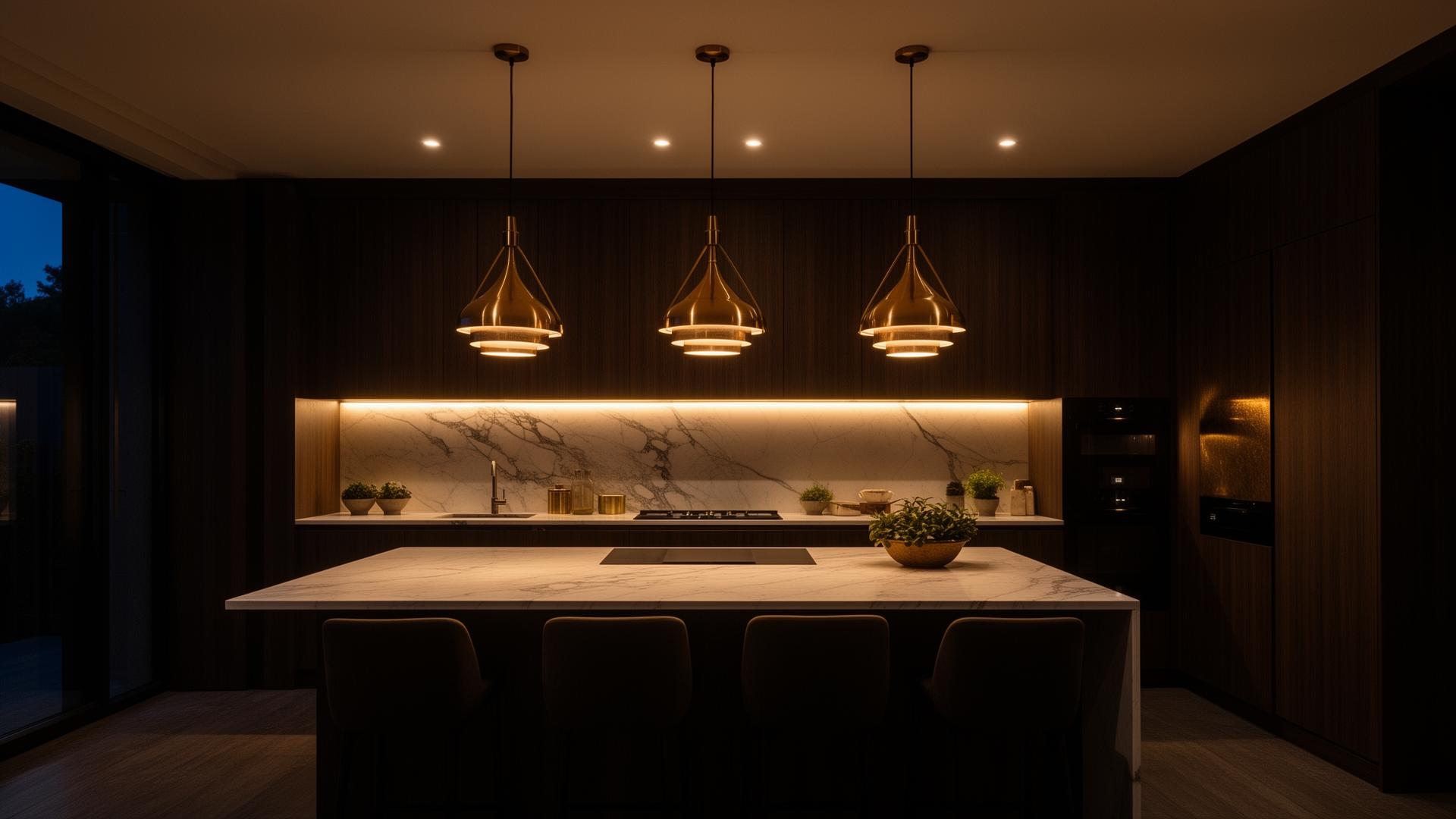
Over the past few years we have walked through hundreds of kitchens — from catalogue flats to premium villas. And we keep running into the same handful of mistakes that turn a technically perfect kitchen into a space that is unpleasant to work in and impossible to relax in after dark. Here are the five most common.
1. One ceiling fixture „so there's light“
The most widespread mistake: a single central ceiling fixture meant to light the entire room. The result is a flat, impersonal ceiling, hard shadows on the worktop and no atmosphere after sunset.
A well-designed kitchen runs on at least three layers of light: ambient (overall, soft), task (directly on the worktop and hob) and accent (island, open shelving, splashback). Each layer lives on its own circuit with its own dimming level.
„A single fixture never creates atmosphere. Atmosphere is born from the contrast between layers."
2. A worktop without under-cabinet light
Upper cabinets shadow every ceiling lamp — when you stand at the worktop, your own body throws a shadow onto the very place where you are chopping. Without under-cabinet light you work in a half-shade and your eyes tire fast.
An LED strip under the upper cabinets (CRI ≥ 95, 3000 K, with an anti-glare diffuser) is a quiet investment of 200 – 400 € on a typical kitchen. It saves your everyday cooking and shows ingredients in true colour — a tomato looks like a tomato, meat has its real tone.
3. The wrong colour temperature above the island
Cold 4000 K light above a dining island turns the kitchen into an operating theatre. A pleasant dinner, a glass of wine after work or a family breakfast simply don't work under that light — it feels clinical and pushes you toward performance, not comfort.
For a kitchen that doubles as a dining and gathering space, use 2700 K (warm white). The ideal solution is tunable white — 4000 K in the morning for cooking and sorting the shopping, a smooth shift down to 2200 K in the evening for a Fine dining feel.
„Colour temperature decides whether you stand up after dinner and leave, or stay at the table for another hour."
4. No dimming
A dimmer in the kitchen is not a luxury, it is a functional baseline. Without it you have two states: full light or darkness. Yet different parts of the day demand completely different levels.
- Breakfast: 70 – 80 % on the ambient circuit, 100 % task.
- Daytime cooking: 100 % task, 50 % accent.
- Family dinner: 30 % ambient, 40 % accent above the island.
- A glass of wine after work: 10 – 15 % everywhere, accent dominant.
- Night-time walk to the fridge: 5 % floor-level orientation light.
Without dimming you have none of these scenarios — you have an office that blazes at full output until the moment you switch it off.
5. Pendant lights at the wrong height
Beautiful designer pendants above the island lose their purpose at the wrong height. Too high — the fixture „floats“ in the room, distracts the eye and fails to light the worktop. Too low — it glares into the eyes of anyone seated and blocks the view across the island.
Reliable rule: bottom edge of the fixture 75 – 85 cm above the island worktop. For taller islands or a bar counter, adjust to the seated person's eye line. With several pendants in a row, keep the spacing even and keep the outer edge at least 30 cm from the ends of the island.
„A pendant at the wrong height is not a design detail. It is a daily mistake you notice every time you use the kitchen."
In closing
The kitchen is the hardest room to light because it has to work simultaneously as a work surface, a dining room, a meeting place and sometimes a home office. These five mistakes are cheapest and easiest to solve at the design stage — never after the handover.
„A well-designed kitchen does not just change the way you cook. It changes the way you spend your evenings at home."
Premium Light Studio
We design lighting with focus on the quality of light, not just on fixture wattage.
Discuss a project