Why luxury hotels use warm light
Warm light is not an aesthetic choice. It is the tool hotel architects use to move a guest from daytime performance into evening recovery — and the reason they want to come back.
Luxury hotels don't use warm light by accident. Light directly affects the nervous system, emotions and the sense of comfort. Here is why fine hotels treat colour temperature in a completely different way than ordinary interiors.
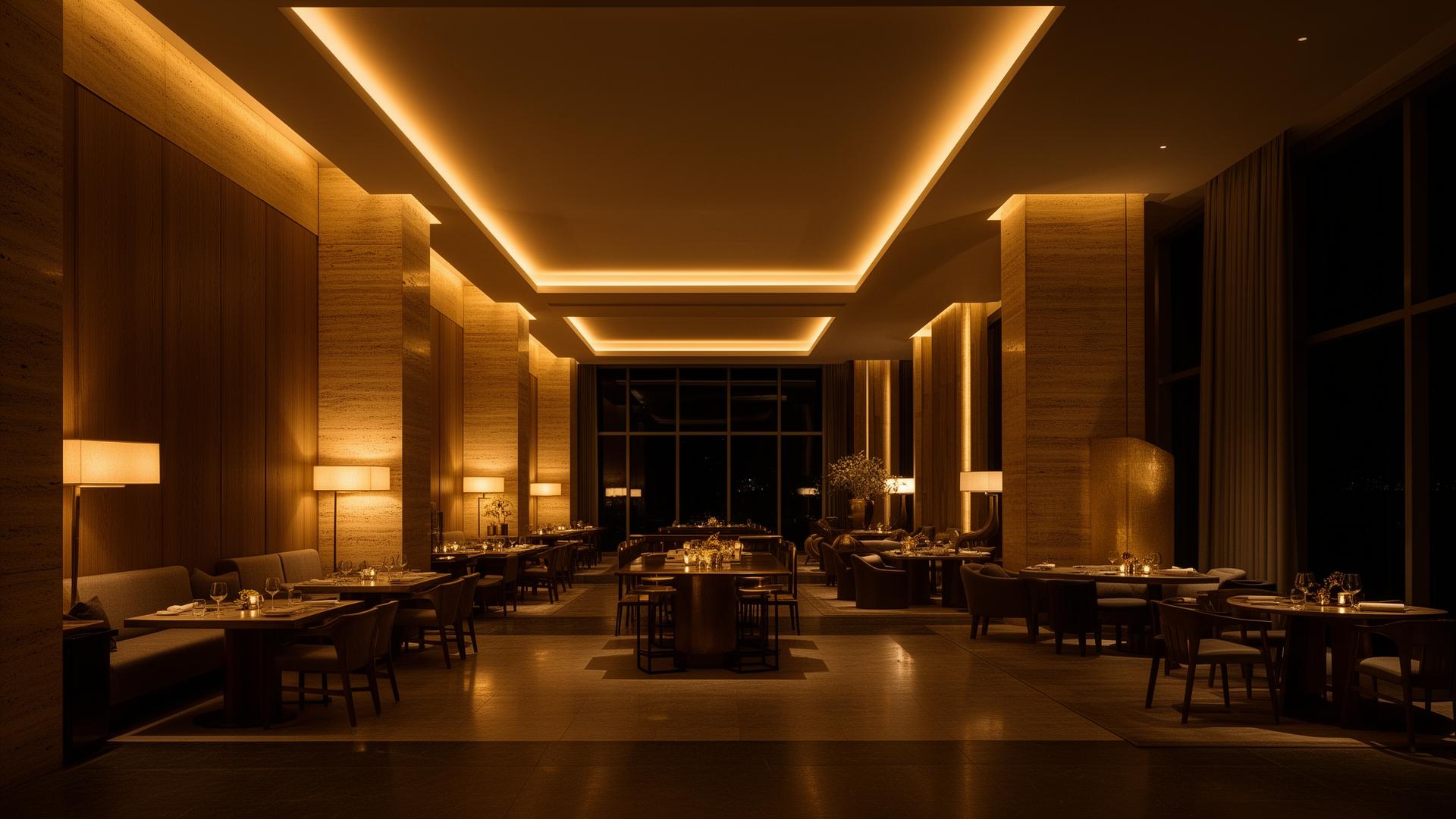
When you step into the lobby of a five-star hotel, something shifts in your body before you can name why. Your shoulders drop, your breathing slows, your eyes stop working. It isn't the furniture or the scent in the air — it's the light. Specifically, its colour temperature and the way it is distributed across the room.
1. What colour temperature really means
Colour temperature is measured in kelvin (K) and tells you whether light feels „warm“ or „cool“. Anything below 3000 K reads as a warm, yellow-orange light close to a candle or sunset. Anything above 4000 K is neutral to cool blue-white, similar to midday daylight.
Luxury hotels operate almost exclusively in the 2200 – 2700 K range. Cheap hotels, motels and office spaces are typically set to 4000 K or higher — because it is the cheaper LED solution and „you get more lumens for the same money“. The body feels the difference instantly.
„Cool light tells the body it is daytime. Warm light tells it it is time to rest. The hotel that understands this sells comfort — not a room."
2. Why warm light calms you
The human circadian rhythm reacts to light through photoreceptors in the retina that communicate directly with the hypothalamus. The blue component of light (4000 – 6500 K) suppresses melatonin — the hormone that prepares the body for sleep and recovery. Warm light with little blue does not suppress melatonin, so the body gets the signal „it's evening, I can let go“.
For a guest who has just arrived from the airport, a meeting or eight hours behind the wheel, that transition is critical. A hotel with warm light lets the body switch from performance to recovery already at check-in. A hotel with cool LED in the lobby keeps the guest wound up for another hour — and then they cannot fall asleep.
3. Layering light in hotel spaces
A luxury hotel never relies on a single light. It works with at least three layers, combined by function and time of day:
- Ambient light — indirect illumination from coves, walls and recesses. Sets the overall mood, never too bright.
- Accent light — narrow beams on artwork, stone cladding, floral arrangements. Adds depth and visual anchors.
- Functional light — reception desk, reading lamps in the lobby, stair lighting. Higher intensity, still in the warm 2700 K spectrum.
- Decorative light — candles, fabric shades, fixtures with a visible bulb. Their purpose is not to illuminate — it is to be seen.
These layers are never on a single switch. Each lives on its own DALI circuit, driven by scenes: morning check-out, afternoon coffee, evening arrival, late-night reception. The guest never sees it — but feels the room behaving „naturally“.
„In a luxury hotel there is no single light. There are 6 – 8 layers that fold and unfold throughout the day according to what the guest needs."
4. Low intensity is not a lack of light
The most common misunderstanding: people assume a luxury hotel has „too little light“ and that is why it feels dim. In reality, there is just as much light — it is simply split between many sources, none of them at full output and none of them glaring. The eye sees soft contrast instead of one flat luminous surface.
The goal is not to flood a space, but to light exactly the places that matter: the reception counter, the path to the lift, a material detail, the face of the waiter at the table. Everything else stays in the background. That is the difference between atmosphere and warehouse lighting.
5. The hotel room — the hardest space
A room is extremely demanding because a guest uses it in many modes: arrival with suitcases, shower, work on a laptop, room-service dinner, reading before sleep. Each mode needs a different light.
- Entering the room: 30 % ambient at 2700 K — the guest sees where they are without glare.
- Bathroom routine: 100 % functional at 3000 K with CRI ≥ 95 — true skin tone for make-up.
- Desk work: 70 % task lamp, 40 % ambient.
- Dinner / reading: 20 % ambient, 60 % accent above the chair.
- Before sleep: 5 % floor-level orientation light at 2200 K — the body gets the „sleep“ signal.
A well-designed hotel room has one bedside panel with no 15 switches — only 4 scenes. Welcome, Work, Relax, Sleep. The guest never thinks about which switch does what. They press Relax and the room sets itself.
„A hotel room with 12 switches is a technical mistake. A hotel room with 4 scenes is a design decision."
6. Hotel fine dining and colour temperature
In a fine dining restaurant the light shifts dynamically through the evening. At 18:00 the room opens at 3000 K and 60 % intensity — the guest reads the menu, browses the wine list, orients themselves. Around 20:00 a slow transition begins toward 2400 K at 35 %. By 22:00 the room sits at 2200 K and 20 %, dominated by candlelight and accent beams over the tables.
The guest never perceives this as a change — only that the atmosphere „matures“ with the evening. Food on the plate looks better, the wine glass glows in warm light, the partner across the table sits in soft light with no harsh shadows.
7. Bringing it home
The principles luxury hotels rely on also work in private homes. The difference is not technological — DALI fixtures with CRI 95+ and tunable white are available to any project. The difference is in the thinking: the space is designed around daily scenarios, not around switches.
- Bedroom: scenes Wake, Read, Sleep — instead of a ceiling light and a table lamp.
- Living room: scenes Work, Movie, Dinner, Late Night — instead of a central chandelier.
- Bathroom: tunable white 2700 – 4000 K according to time of day and activity.
- Hallways: night mode at 5 % near the floor after midnight — no glare on waking.
Such a system is 15 – 25 % more expensive than a conventional install. The value it returns is not measured in euros — it is measured in how you feel in the space after a hard day.
8. In closing
Luxury hotels use warm light because they know what they sell. They are not selling a room — they are selling a state. A state in which the body knows it is safe and can let go. That state is created by light before materials, scent or music.
If you want your home to work the same way — to actually arrive „home“ rather than into another illuminated room — start with the light. It is the cheapest and most powerful component of the entire interior.
„You remember the hotel you want to return to by how it made you feel. And how it makes you feel is decided by light."
Premium Light Studio
We design lighting with focus on the quality of light, not just on fixture wattage.
Discuss a project