DALI vs. classic dimming: when it pays off
Not every dimming is intelligent lighting control. The gap between classic dimming and a DALI system is wider than most investors realise.
DALI is not merely a „smart switch“. It is a digital bus that changes how a space responds to the time of day, to scenes and to the user.
1. What classic dimming is
Classic dimming — also known as phase-cut or TRIAC dimming — is an analogue approach to light regulation operating at mains-voltage level. The dimmer simply „cuts“ part of the 230 V sine wave, reducing the power delivered to the fixture. It is a proven, cheap and easy-to-install technology that has worked in millions of homes for decades.
Its limits show up on more demanding projects. A dimmer controls a whole circuit as a single unit, not individual fixtures. It has no memory, no scenes, no feedback. Adding another circuit means a new cable and a new dimmer. For a small flat that is enough — for a complex interior it is a wall you cannot get past.
„A classic dimmer decides on voltage. DALI decides on how a space feels."
2. What DALI is
DALI (Digital Addressable Lighting Interface) is an international standard for digital communication between fixtures and a control system. Every fixture on the bus has its own address — you can control it individually, group it, or assign it to a scene without rewiring. Communication runs on two thin conductors carried alongside the mains supply.
DALI is not a „better dimmer“. It is a whole ecosystem: scenes for parts of the day, automations responding to daylight or presence, time schedules, smooth transitions, tunable white (2200 K to 6500 K) and deep integration with Smart home platforms such as Loxone, KNX, Crestron or Apple Home.
3. The main differences between DALI and classic dimming
- Dimming precision — DALI offers logarithmic dimming from 0.1 % to 100 %; a classic dimmer is typically 10 – 100 %.
- Flicker — DALI drivers are designed to be flicker-free even at low levels; phase-cut often flickers at low output.
- Number of controlled circuits — DALI: up to 64 addresses per bus, unlimited through gateways. Classic: 1 circuit = 1 dimmer.
- Flexibility of changes — regrouping fixtures via an app vs. physically rewiring the installation.
- User comfort — scenes, automations and voice control vs. a single rotary knob.
- Future expansion — you can extend a DALI system with sensors, panels or a KNX integration at any time without touching the walls.
Classic dimming also keeps throwing three problems at us: visible flicker (especially with retrofit LEDs), driver buzz caused by dimmer/fixture incompatibility, and instability at low output where the light „jumps“ or cuts out.
„DALI does not make light brighter. It makes it controllable — and in a luxury interior that is a fundamental difference."
4. When classic dimming is the right choice
Not every project needs a digital bus. Classic dimming is right where the installation is small and control requirements are basic.
- Smaller flats under 80 m² with a single lifestyle pattern.
- Simple interiors with 3 – 5 lighting circuits.
- Projects on a tight budget, where fixture quality outranks control.
- Renovations where a new DALI bus simply cannot be run.
- Basic scenarios: on, off, dim.
In these situations a good TRIAC dimmer or a wireless solution like Casambi (BLE) is fully sufficient, both economically and functionally.
5. When DALI pays off
DALI becomes the only right answer wherever a space changes function throughout the day, or wherever the client expects precise control over atmosphere.
- Luxury residences — villas above 200 m², penthouses, multi-zone apartments.
- Large open-plan spaces with layered lighting.
- Hotels — reception, lobby, rooms with individual guest scenes.
- Offices — automatic regulation by daylight and occupancy.
- Fashion Retail and showrooms — precise day-time and evening scenes.
- Wellness and spa — slow transitions, colour temperatures, relaxation modes.
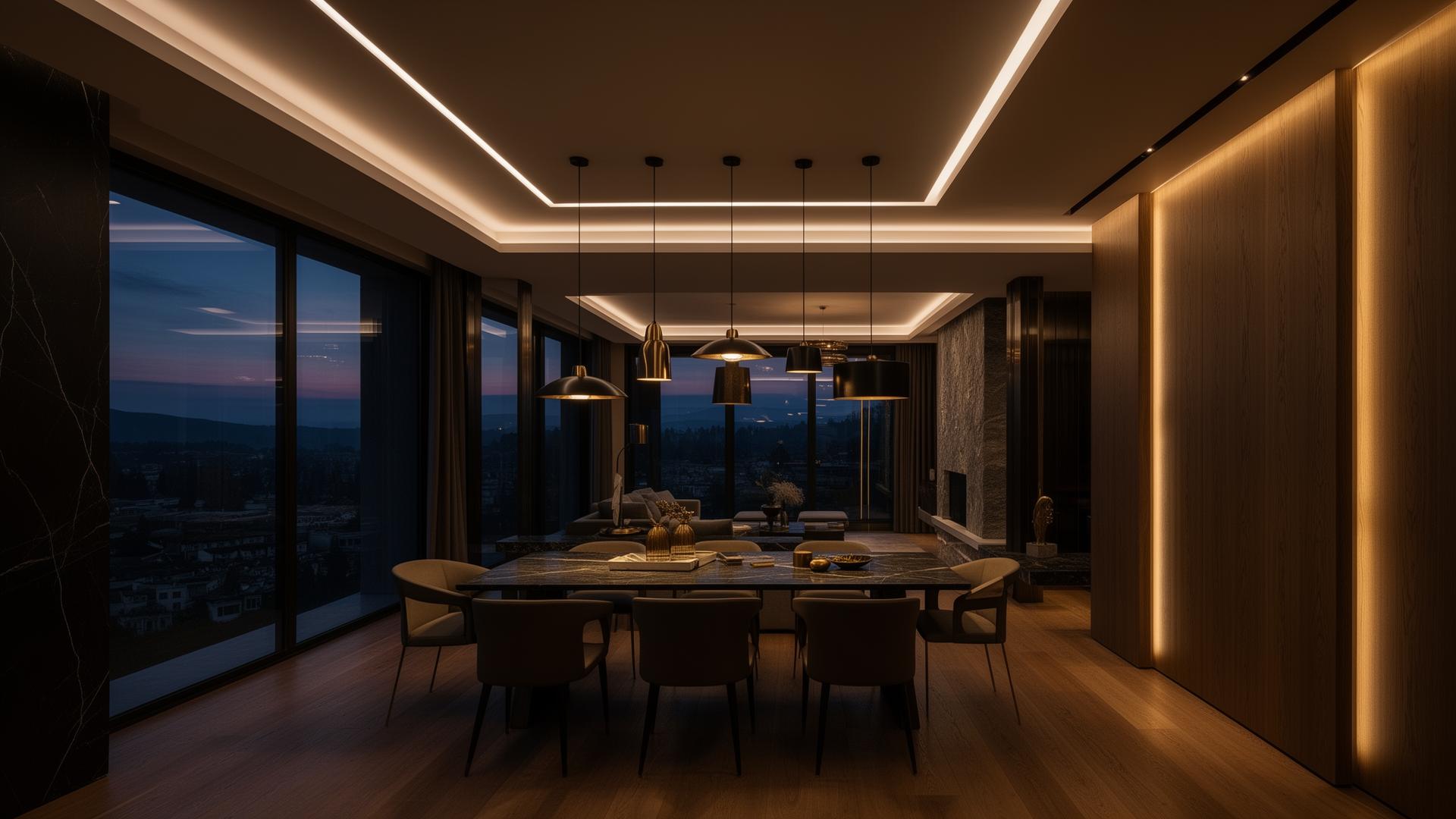
The real value lies in scenes that actually transform the space: warm 2200 K above the dining table in the evening, neutral 4000 K in the kitchen for work, 1 % floor-level orientation light at night, automatic switching at sunset. None of this is reachable with classic dimming — it has no memory and no coordination.
6. The biggest mistake in lighting design
The most common mistake on the investor's and architect's side: the project obsesses over fixtures — brands, looks, wattage — and only solves control at the very end, as an afterthought. The result is beautiful fixtures hanging in a room that only knows on and off.
A quality lighting system is not just about what shines. It is about how the space responds to a person across the day — how it gently rises in the morning, how it shifts into a warm evening, how it adapts to daylight. This is designed at the start, never bolted on later.
„Choosing fixtures is 30 % of the project. How you control them is the other 70 %."
7. In closing
DALI is not the universal answer, but where it fits it is irreplaceable. The investment in digital control returns as comfort that holds up for decades and as the freedom to reshape a space without touching the walls.
„Quality lighting today no longer ends with picking a fixture. Real comfort only appears when light can respond to the space, the time and the user."
Premium Light Studio
We design lighting with focus on the quality of light, not just on fixture wattage.
Discuss a project